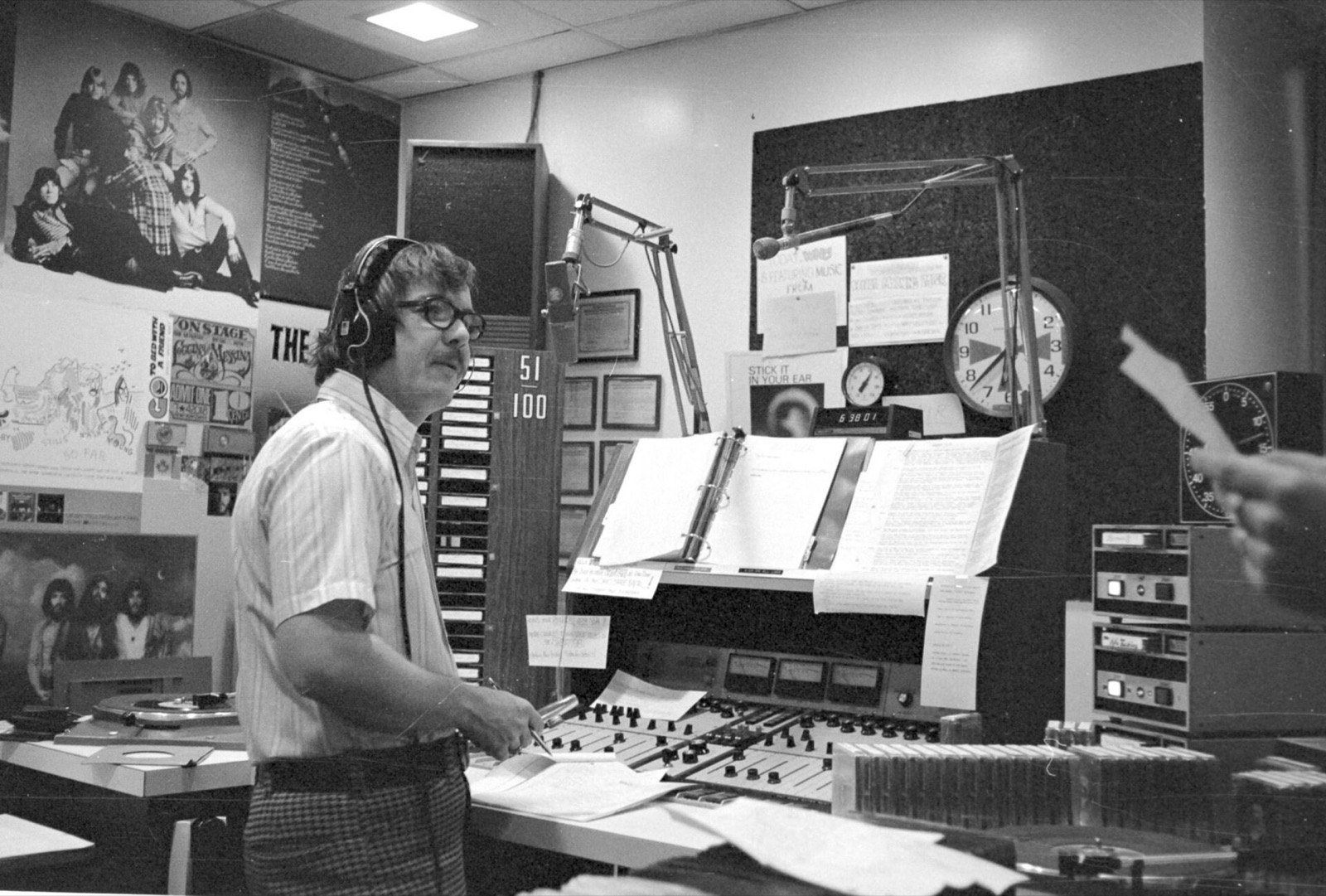
The canon
- The CHUM generation (1957–1970s) — Toronto's 1050 CHUM invented the Canadian hit parade, and its fast-talking personalities made records matter weekly. The station's charts and spins gave early Canadian acts — from the Crew-Cuts onward — their first national platform.
- David Marsden (CFNY, 1977–1988) — The founder of Canadian alternative radio (see our CFNY feature): a programmer-DJ whose entire doctrine was lead, don't follow, breaking new wave, punk, and Canadian independents years ahead of the mainstream.
- Dave Booth — the CFNY morning institution whose decades on Toronto airwaves made him the alternative format's longest-serving voice.
- Denise Donlon — from MuchMusic's executive ranks to radio, a taste-making career across both media.
- Kurt St. Thomas — the Edge-era DJ whose championing of emerging acts through the 90s exemplified the modern-rock gatekeeper.
- Humble & Fred — Toronto morning radio's music-obsessed institution, whose love of Canadian rock made them a broken-record? — keep it clean: whose championing of Canadian rock made them an unofficial national A&R department with breakfast banter.
- Alan Cross (CFNY/the Edge, 1993–present) — The Ongoing History of New Music turned a DJ shift into the country's most respected music journalism: deep dives, Canadian-priority storytelling, and a historian's memory inside a working radio career. Cross didn't just play Canadian bands — he explained them, episode by episode, for thirty years.
- The campus radio generation — CKDU Halifax, CKLN Toronto, CITR Vancouver, CJAM Windsor: the unpaid, unglamorous tastemakers who broke Sloan, the hip-hop underground, and every scene the commercial dial was too slow to hear.
What the DJ era actually did
A DJ's power was a strange alchemy of scarcity and trust: three minutes of airtime was precious, and the audience believed the person spending it. When a DJ played a local demo on a Tuesday night, it was an argument — this is worth your time — backed by nothing but conviction and reputation. Careers launched on such arguments: the Halifax bands CKDU spun into national stories, the Toronto hip-hop records CKLN played when no commercial format admitted the genre existed, the new wave singles Marsden championed that MuchMusic later turned into hits.
The handoff
The algorithm took the scarcity out of the equation — infinite slots, no trust required — and the DJ's gatekeeping role dissolved into metrics. But the function didn't disappear; it mutated. The Ongoing History still airs. Playlist editors (see our feature) are the industry's new DJs. And the lesson the great ones taught survives wherever curation matters: taste is a service, conviction is a credential, and the most important three minutes in a band's life are still the ones somebody brave decides to play.
Frequently asked questions
Who is the most influential DJ in Canadian music history?
The CHUM generation invented the role, David Marsden invented alternative radio, and Alan Cross invented music-history radio — three founding figures, three eras.
What was Alan Cross’s Ongoing History of New Music?
A long-running radio series that treated rock history — with heavy Canadian priority — as serious, deep-dive journalism, influencing generations of listeners and musicians.
Do DJs still break Canadian bands?
Less than campus and community radio once did — but campus stations, streaming playlist editors, and music journalists carry the function forward.